
Home / Guides / Cotton drawstring bag size guide: measure your product, then pick the pouch
Cotton drawstring bag size guide: measure your product, then pick the pouch
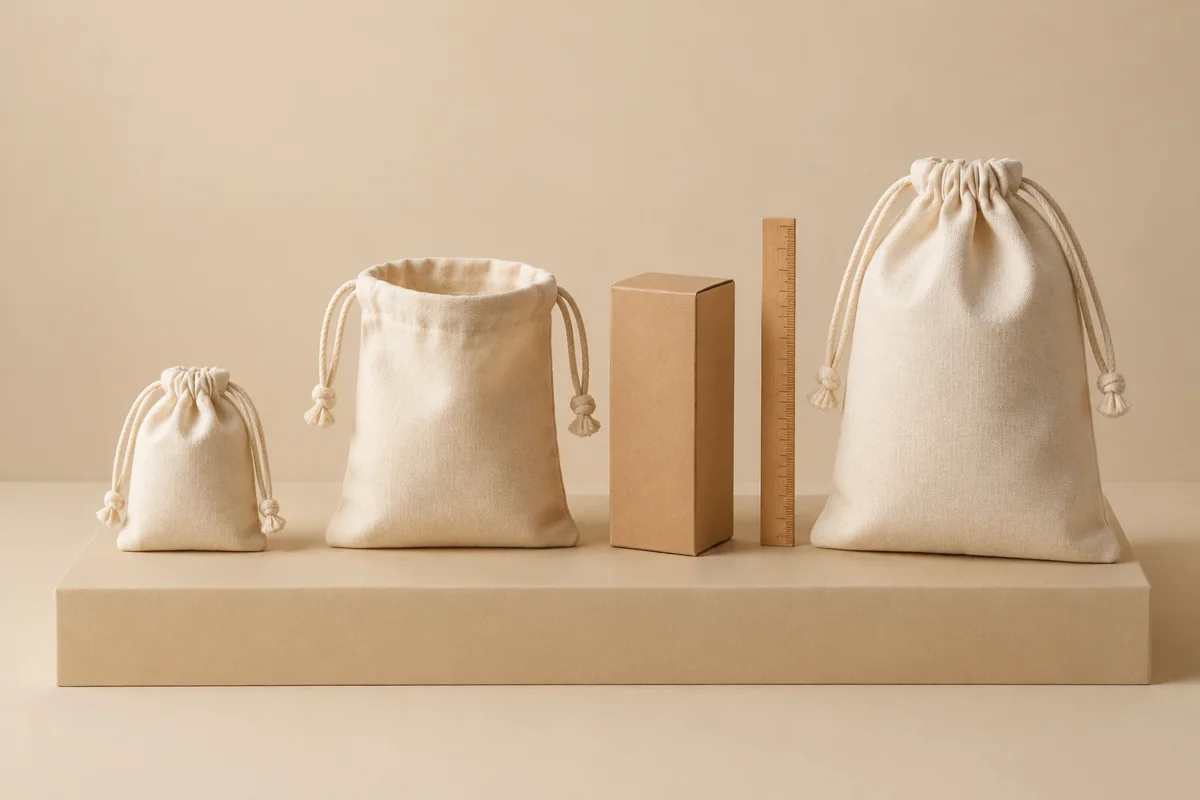
A pouch can look roomy when empty and still refuse to close around a box. The missing measurement is usually depth: a flat bag has to wrap around the sides as well as cover the front. For a bulk packaging order, start with the finished product, including its carton, insert or protective wrapping. Then test a sample with the drawcord fully closed.
This guide is for buyers choosing cotton drawstring bags in bulk for jewellery, accessories, boxed gifts and product kits. It explains how to write a useful size specification without treating a nominal pouch size as a fit guarantee.
Flat size and usable space are different
Suppliers commonly describe a pouch by its empty, flat width and height. Confirm the measurement method before comparing quotes. Ask whether the stated height includes the drawstring channel and how much usable depth remains below it. Seams, the channel and the space needed for gathering all affect what fits.
- State width first and height second, and write the unit beside both measurements.
- Confirm whether dimensions are external or internal, and whether the bag is flat-bottomed or has a gusset.
- Ask for the agreed size tolerance on the finished bag.
- Check the opening as well as the body: the product must pass through it without forcing the seams.
Measure the packed product in three directions
- Pack one complete item exactly as it will reach the customer. Include the box, sleeve, tissue and any insert.
- Measure its widest width, greatest depth and full height. For a soft item, fold it consistently before measuring.
- Note sharp corners, fragile finishes and parts that can catch on the cord or seams.
- Send those measurements with a photograph of the packed item and explain whether each pouch holds one item or a complete set.
Do not choose from the product name alone. Two candles can have very different vessels; a jewellery card may be wider than the jewellery; a folded garment changes size with its folding method. Size the actual pack.
A worked box example, not a guaranteed bag size
Imagine a rigid carton measuring 8 cm wide, 4 cm deep and 12 cm high. A flat pouch only 8 cm wide is not a sensible starting point: its fabric must also go around the 4 cm depth. Width plus depth gives 12 cm as an initial geometric reference before clearance, seam construction and fabric behaviour are considered. It is not an order-ready size.
Height needs its own check. The base wraps under the carton, while fabric above the carton must gather without pressing the contents. Ask the supplier to recommend a sample from the complete 8 × 4 × 12 cm pack measurements. Test the proposed finished pouch rather than adding one universal allowance to every product.
What to check for each packaging use
| What goes inside | Measure or confirm | Sample-fit check |
|---|---|---|
| Jewellery on a display card | Full card width and any protective wrap | Card slides in; corners do not catch |
| Boxed soap or cosmetics | Outer carton, not the bare product | Cord closes without crushing the box |
| Candle or rigid gift box | Widest diameter or width, depth and height | Base sits fully inside; top gathers comfortably |
| Clothing or accessories | Consistently folded finished pack | Item removes easily without stretching seams |
| A multi-item kit | The complete arranged set | Contents stay arranged when the bag is lifted |
A fabric pouch is not automatically a protective shipping container, a food-contact pack or a leak barrier. Keep any required inner packaging and ask for evidence for the intended use. Do not infer suitability from a natural-looking fabric.
Choose the fabric after the fit is clear
Compare fabric samples for opacity, feel, weave and how the pouch gathers. A lighter fabric may drape around a small item; a firmer fabric changes the feel and bulk of the pack. Weight alone does not prove strength or protection. Review stitching, seams and the closure on the actual sample.
Start with the mini cotton pouches, small cotton drawstring bags or medium cotton drawstring bags range as a conversation starter. Confirm the finished dimensions for your order rather than assuming a size label means the same thing across styles.
Leave the logo away from the gathered top
Artwork approved on a flat outline may wrinkle or disappear when the pouch is filled. Ask for the printable area below the channel, the distance from seams and a proof showing the logo on the chosen size. Then check the filled sample from the front. A small pouch needs a design that remains clear at its actual printed size.
Use the printing-methods guide to prepare artwork questions, or browse custom logo drawstring bags. Confirm the method on the chosen fabric instead of assuming every method suits every pouch.
Run this sample check before approving the bulk order
- Load the complete item without pulling hard on the opening.
- Close both drawcords and check the top gathers comfortably.
- Lift and reopen the pouch several times with its intended contents.
- Inspect seam tension, cord attachment, the base and any contact with sharp edges.
- Check the printed logo with the pouch filled and closed.
- If washing matters, agree the care method and test a sample before finalising a close-fitting size.
- Record the approved finished dimensions, tolerance, fabric, cord, artwork position and packing arrangement together.
What to include in your quote request
Send the packed product dimensions, one-item or set quantity per pouch, total order quantity, fabric preference, logo artwork, delivery destination and required date. Add any special requirements for the inner packaging or handling. A sample photograph beside a ruler is more useful than asking for a medium bag with no context.
Ready to check the fit? Browse the drawstring range and request a quote using the form below. Include your product measurements so the proposed pouch can be checked against what it will actually hold.