
Home / Guides / Tote bag handle length and drop: what bulk buyers should check
Tote bag handle length and drop: what bulk buyers should check
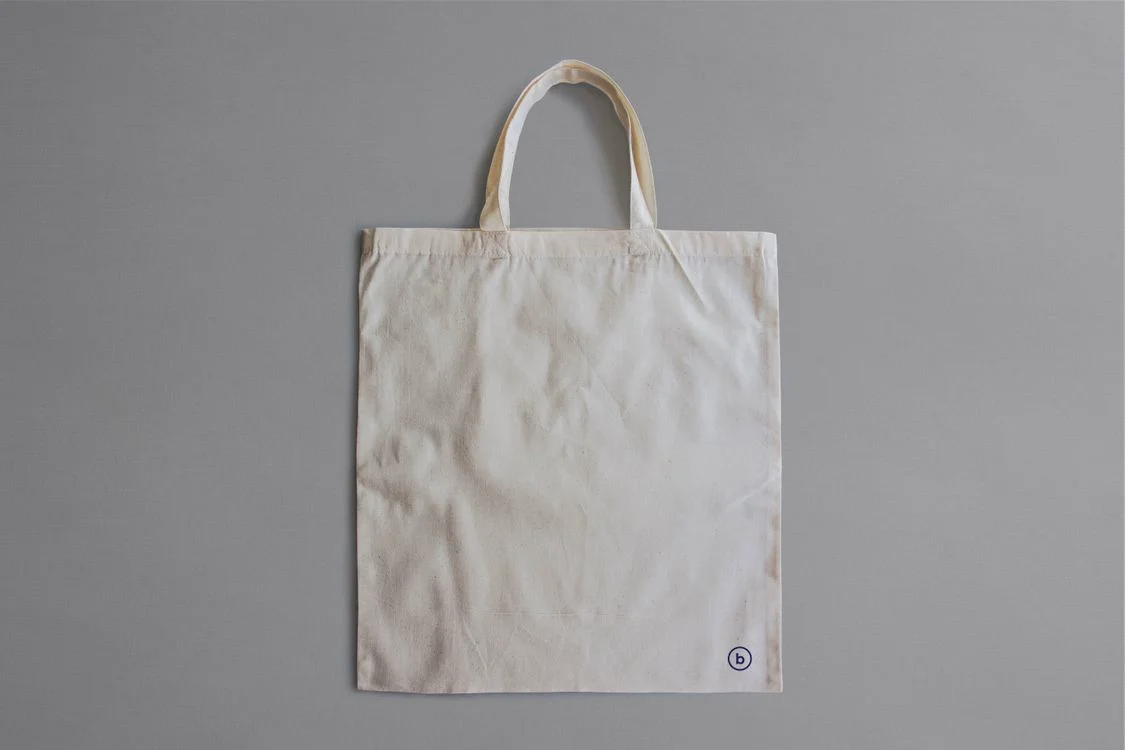
A tote can be the right size for its contents and still be awkward to carry. The handles may fit a bare arm but not a coat, or a tall bag may hang too low when carried by hand. For a bulk order, agree the intended carrying position before choosing a handle measurement from a catalogue.
This guide separates handle length from handle drop and turns a comfortable reference bag into a clearer buying brief. It complements our GSM and size guide: body dimensions describe the bag, while handle measurements help describe how someone will use it. Neither set of numbers guarantees comfort for every user.
Handle length and handle drop are different measurements
Handle length follows the strap around its curve. Handle drop is the straight vertical distance between the top edge of the bag and the top of the raised loop. One is a path along the handle; the other describes the clearance beneath it. They should not be used as interchangeable labels on a quotation.
Suppliers may include the sewn-in ends when stating handle length, or quote only the visible loop. Ask where the measurement starts and finishes. For drop, agree whether the endpoint is the inside edge or centre of the strap and show it on a drawing. A small difference in measuring method can make two quotations look more alike than they are.
| Detail | What to record |
|---|---|
| Finished handle length | Start and finish points; visible loop or sewn-in ends included |
| Handle drop | Vertical measurement, endpoint and measuring condition |
| Finished width | Width after folding or finishing, not the raw strip |
| Attachment spacing | Distance between the two joins, with measurement points labelled |
| Bag body | Width, height and gusset of the same finished sample |
Why dividing handle length by two is not enough
A handle spans the distance between its attachment points as well as rising above the bag. Its curve, stiffness and the spacing of those joins affect the resulting drop. Two bags with the same stated strap length can therefore leave different amounts of room beneath the loop. Do not calculate a promised shoulder fit from strap length alone.
The KMM & Co. drop-length guide describes measuring perpendicular to the top edge without stretching the handle. Its examples concern leather totes, so they are a useful explanation of measurement and personal fit, not a specification for every cotton or jute bag.
Start with the carrying job, not a universal size chart
For retail presentation or a short handover, hand carry may be the intended use. Conference visitors, commuters or shoppers may want shoulder carry. A bag expected to do both needs checking in both positions: enough room over the shoulder does not automatically mean a neat or comfortable hand carry.
Published size charts offer starting points, but their suggested ranges differ. Body shape, clothing, bag height and personal preference all matter. Avoid approving a single drop as suitable for everyone. For a varied audience, try samples with more than one person and include the clothing likely to be worn when the bags are used.
- Hand carry: check that the filled base stays clear of the ground and the handles do not force an awkward grip.
- Shoulder carry: put the bag on and remove it while wearing the intended jacket or uniform.
- Mixed use: repeat both checks with the same contents rather than testing an empty bag only.
- Longer carry: check whether the filled bag swings, rubs or presses into the arm during normal movement.
Measure a reference bag that already works
A familiar tote is a useful starting reference because the buyer can explain what feels right about it. Record the body size and construction alongside the handles. Copying a strap measurement from a small flat tote onto a wide gusseted shopper does not reproduce the same overall fit.
- Lay the reference bag flat and smooth it without pulling the fabric or stretching the handles.
- Raise one handle into its natural loop and measure vertically from the labelled top edge to the agreed point inside the loop.
- Measure the finished strap width, the visible curved length and the spacing between its attachment points.
- Photograph the tape position and label the units, front or back handle, and whether the bag is empty.
- Repeat on the proposed sample using the same method, then compare both bags with the intended contents.
If the two handles differ, record each one rather than averaging away the difference. If a handle stretches under load, separate the unloaded measurement from the carrying trial. Any production tolerance should be agreed with the supplier for the chosen construction; this guide does not set a universal allowance.
Width and attachment need their own checks
Length is only part of the handle brief. Finished width, edge feel, flexibility and the way a handle sits in the hand can change the experience. Wider or padded handles may feel different, but width alone does not prove comfort, durability or carrying capacity. Check the actual material and finished edges on a sample.
Inspect the joins inside and outside the bag. Ask how the handle is secured and what reinforcement belongs to the quoted style. A photograph of a box or cross-shaped stitch does not establish a tested load rating. Where strength matters, agree the intended contents, test method and acceptance criteria rather than treating stitch appearance as proof.
Check the opening, closure and decoration together
Handles can affect access as well as carrying position. Try loading the actual box, clothing pack or event kit through the opening, then bring the handles together. Check that a zip or other closure remains usable and that the handle joins do not obstruct the intended decoration area. Our flat versus gusseted guide covers the separate question of opened bag dimensions.
Browse cotton tote bags or canvas tote bags to identify a starting style. Confirm handle options and measurements for the exact item being quoted; the range page and illustrative photographs are not a promise that every construction or alteration is available.
What to include in the bulk-order handle brief
- Intended hand, forearm or shoulder carry and the typical users and clothing.
- Bag body dimensions, expected contents and the reference sample being compared.
- Labelled finished handle length, drop, width and attachment spacing, with units.
- Handle material, colour, attachment construction and any agreed test requirements.
- The approved sample version, measuring method and agreed production tolerances.
Keep the handle specification with the rest of the sample approval checklist. Ask for any changes to be reflected in the quotation and sample record before bulk approval. The aim is not the longest handle: it is a clearly defined handle that works with the bag, contents and intended way of carrying it.